Wrath of the Lich King: First Impressions
November 17, 2008 by Sydera
Filed under All Stories, Featured
While some of us (ahem, Matticus) are already level 80, most WoW players are still in the thick of the leveling process.
I thought it might be interesting to share some of my impressions so far with all of you, and of course to invite everyone to add their own thoughts and ideas.
Here’s what’s been going through my mind so far.
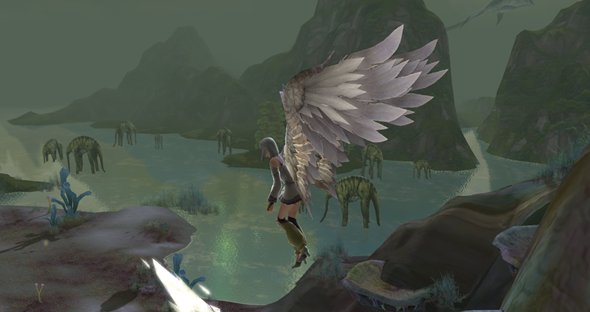
1. The art is amazing! Everything feels sharper, more rich, more detailed than previous versions of the game.
2. I love the shadows. The world has a depth that it never did before.
3. I really appreciate quests where I don’t have to kill 6 of this mob and 8 of the other. The more inventive, the better.
4. I still don’t like robot-themed areas. Fizzcrank airstrip gets a big thumbs down.
5. I’m enjoying all of the prehistoric-ish animals and humanoids. It makes me wonder if the designers read Jean Auel’s Clan of the Cave Bear while they were working on the storyline for the Vykrul. If not, it occurs to me that they would probably like it.
6. I really miss flight form.
7. I’m not a fan of land mounts that jiggle too much–they make me dizzy. That means you, Amani War Bear and Black War Elekk. Either I’ve got to take Dramamine or I’m sticking with the Talbuk.
8. I can’t believe I got to ride on a mammoth for a quest. It was a shame that it was even more wiggly than the War Bear! At least I know not to save my money for the Grand Caravan Mammoth now.
9. I can’t believe I have more gold now than when I installed the x-pac.
10. I never thought I would say this, but I love being a laser chicken, if only for a little while. Go Go Hurricane!
If you're new here, you may want to subscribe to my RSS feed or to E-Mail updates on the top right. Thanks for visiting!
Q&A: How Do I Break Into Raiding?
November 13, 2008 by Sydera
Filed under All Stories, Featured, How to
Copra, a priest from Thunderhorn EU, asked the writers of Matticus such a great question that I thought I would share it with all of you. In his words:
The question is, how on Earth (or on Azeroth, depends on your preferance) are we newcomers going to learn the group dynamics, the class or the requirements of Boss fights? By cutting us out of the instanced content that is the tutorial to raiding 60s, 70s and later 80s instances, there is little hope that the burned out raiders will get replaced by players who are as skilled or as motivated.
Any hints on how to gain that experience early on and how to ‘impress’ the raiding guild leadership before you hit the cap and start making a fool of yourself with your gear and skill?
To share a bit more background, Copra is coming into Wrath of the Lich King with a bit of a disadvantage. He’s a fairly new player who is not yet at the level cap. And yet, Copra, you must take heart! Even brand-new players can break into raiding. However, you can’t really get into a raiding guild before the level cap–the game starts at max level for a raider. Yet, people can, and frequently do, level up new toons and join raiding guilds with them. Here’s my suggestions for getting yourself ready to raid in a few short weeks.
Tip #1: Level fast.
The content of Azeroth and Outlands is enjoyable in its own right. If you had a different in-game goal in mind, I’d say go slow and enjoy the scenery. However, if you want to raid seriously, the first and most important thing you must do is reach the level cap. In order to do this most efficiently, I suggest taking on the kind of quests you can solo. No instances, no group quests, no stopping. When you hit 58, go to Outlands. When you hit 68, go to Northrend.
If you join a guild during the leveling period, understand that you’re teaming up for company rather than instance runs or old-school raids. It might seem like a good idea to have higher-level players run you through stuff, but the XP gain per hour is not nearly what you could achieve with the same time spent questing on your own. The best type of guild to join pre-80 is what’s called a leveling guild. Essentially, these organizations are fun, casual associations of people who like to share the same guild chat.
Tip #2: Save your money.
You can reach level 80 in your underwear–no really! It’s not recommended, but I’m sure there are players who will do it for kicks. It is important, however, not to spend your time or resources acquiring gear at 60 or 70, particularly the craftables. Once the content goes by, its craftables and BoE items quickly become obsolete. You’ll spend days tracking down Frozen Shadowweave, and the return will be negligible. Your gear from quest rewards will be enough.
Tip #3: Hold off on crafting professions.
Most of the gathering professions, with the possible exception of mining, can be raised to the cap while you level without any inconvenience whatsoever. However, the crafting professions are an enormous pain in the booty. My advice is to take either herbalism or mining and skinning as your professions and sell all the proceeds. Bank and bag space are at a premium when you’re leveling fast. At max level, you can decide what your crafting profession(s) need to be and worry about it then.
Tip #4: Respec for success
Research your class a bit, and as soon as you hit max level, spec into the role that is most desirable for raiders. Sometimes there’s one right answer for a class, but most often, you have multiple viable options. I suggest a dps or healing spec. While a tank finds all the pickup heroics he wants, raiding guilds always have too many. I do not recommend a tanking spec if you’re looking to break into raiding on the late side. Healing, however, tends to be in demand, and most guilds can sneak in one more dps. For a class that would be attractive to raiding guilds, my money is on Alliance Resto Shaman. In contrast, rogues and warriors would probably have a more difficult time breaking into raiding late.
Tip #5: Once you hit max level, PuG, PuG, PuG
Many people hate pickup groups. Don’t be one of those players! Sometimes you will meet nice people and great players. At the worst, you’ll learn a lot, because you’ll be working hard to compensate for other people’s mistakes. These max-level PuGs are where you will do your learning. There will be growing pains, but it’s worth it. PuG for 5-mans, heroics, and Naxx-10 if you can. If you’re lucky, someone will recruit you for their guild.
Tip #6: Research your class
Read voraciously about your class and spec. There are a lot of places with good information. Read WoW blogs! If you’re here on Matticus, you’ve made a good start. I predict that in a couple of months there will be a rash of “gearing up for Naxx” posts. Read them and follow the advice. When I recruit, one of the things I check for on someone’s armory is class knowledge. Have the right gems, enchants and spec–it will open doors.
Tip #7: Spend your gold
You’ve been using those gathering professions to make money, right? Now is the time to spend it. Improve your gear by buying BoE blues (that you will then fully gem and enchant). If you’re rich enough, now is the time to level a crafting profession. Make sure it’s one that gives your class a special advantage.
Tip #8: Apply to a Naxx-10 guild
By the time you hit 80, the first wave of raiders will have moved past the first tier. However, my experience with TBC tells me that there are always guilds out there that focus on the first instance. There are still active Kara guilds now! Find a Naxx-10 guild that’s no more than halfway through the instance. That way you will get to do all the learning with them. What you don’t want is a more experienced guild. You want to be there for a lot of the first kills so you can have the experience that goes along with all the wipes.
Tip #9: Apply to a Raiding Guild
With Naxx-10 cleared a few times, you have probably gained the basic skills of a raider. Now is the moment to apply for the next tier. This likely means switching guilds. Of course, you’re going to be quitting your Naxx-10 guild respectfully, right? Part of that means not taking uber loot if you know you’re leaving soon. Apply to guilds on and off the server. Look for an organization that has the chops to do 25-mans but isn’t too far beyond Naxx. You might even move laterally, over to a Naxx-25 guild. Alternately, if your Naxx-10 guild has the skills to move on in the 10-man bracket, just stick around and progress with the same group! 10-man progression provides a real alternative in Wrath to the mega-guilds.
Tip# 10: App to Impress
If you do decide to change guilds, make sure that, in your written application and/or your interview, you communicate your enthusiasm for raiding and for the new guild. Nothing impresses me more than effort–make that guild application shine. Note: monosyllabic answers bad, demonstrated knowledge of class good.
And just remember–nothing is impossible. If you have the will to work toward a goal, you will succeed. I bet a player could start today and be ready for raiding in a couple of months. The other lesson is this–the World of Warcraft is immense. If you’re willing to spend time looking, there is always a guild to suit your needs.
A Burning Crusade Retrospective
November 8, 2008 by Sydera
Filed under All Stories, Featured
Ah, the Burning Crusade, how I loved thee. On the eve of the expansion, I think it’s time to take a look back at some of the high points of BC. Mind you, I can only speak for myself, and my personal journey. I’m sure there are players out there–and probably even better players than me–who found their glory days in Classic. However, the expansion was where I, and Syd of course, made the difficult transition from total noob to raider. I’m proud of my progress, but I couldn’t have done it without the support structures that the game itself put in place.
Leveling
Perhaps the most dramatic difference between Classic and BC had to do with the leveling content. Once I stepped through the dark portal, I knew that I had entered an entirely new world (and it had nothing to do with the two moons and the streak of interstellar dust hanging overhead). Quests were conveniently grouped, and most could be done quickly. Now, in the interest of full disclosure, I ought to tell you that I bought the expansion two weeks late, and that when BC was actually released, Syd was only level 40. I probably hit Hellfire three weeks after the crowd, so it truly was an open world and I was able to blaze through.
However, I leveled Syd with the Vanilla WoW mindset. I did every quest in the zone that was appropriate for my level, assuming that in order to get enough XP to level up, I’d have to shift between, say, Hellfire and Zangarmarsh, like players had to do between Alterac, Stranglethorn Vale, and the Badlands. Imagine my surprise when Syd hit 70 after finishing less than half of Nagrand. On the whole, the leveling experience was quick and convenient.
Preparing for Karazhan
The old Karazhan attunement required an extended tour of level 70 dungeons. At minimum, players had to complete a full run of Shadowlabs (minus Murmur if you just couldn’t get him), a partial run of Steamvaults, a partial run of Arcatraz, and full runs of Old Hillsbrad Foothills and Black Morass. For the first few players in a guild to reach 70, runs of Sethekk Halls, Mechanar, and Botanica were needed for the keys to some of these lovely places.
The Karazhan attunement was the first thing I ever did in WoW in a businesslike, logical manner. I had raided a bit at 60, but let’s just say that I didn’t take ZG or MC as seriously as I could have. In order to get myself into Karazhan, I organized groups–who sometimes couldn’t clear the whole instance–and somehow pulled myself through it in greens and a Dreamstate spec. And then, all dimensions were open to me–I could get in the door to Karazhan.
Noob vs. Karazhan
I still remember my first Karazhan raid. It was led by a relatively experienced holy paladin, who shortly thereafter moved on to a raiding guild on another server. I managed to be Karazhan attuned right around the time that the leading players in my casual guild killed Prince for the first time. I started in my guild’s “B-team” Karazhan, and boy, did we deserve that distinction. I had 700 +healing when I walked into Attumen’s room for the first time, most of it “of Healing” greens (and cloth, at that). We did clear Attumen, but Moroes was a disaster. I realized that I needed to go back to the drawing board–way back. Even though I continued to run Kara when I could, I started running level 70 instances and the easiest heroics. I also leveled my tailoring and put myself in the PMC set.
14 Runs of Heroic Mech
Briolante decided that, in order to tank in Karazhan, he was going to need a Sun-Eater. We were clearing at least to chess around this time, and he had decided that the King’s Defender was in fact cursed and was never going to drop (turns out he was right, and it would be another 6 months before he’d see one of those–incidentally, a week before he’d get the Mallet of the Tides off Lurker). The Sun-Eater likewise suffered from the Curse of Tanking Drops, and it took us 14 runs over about 16 days to get the thing. In the process, I became a better healer. Heroic Mech was a little too hard for us in our blues–no one in our typical groups had gotten much out of Karazhan yet. I had to drop tree form to Healing Touch Brio through the Arcane Protectors’ Charged Fist effect, and I had to actively manage my mana to make it through the gauntlet. Pathaleon, who can still give a healer problems with his adds, taught me that NOT healing at the right moment can be just as important as healing. I waited until Pathaleon’s adds were targeting someone else, and then I followed with a Nature’s Swiftness-Healing Touch on Brio. I still usually died during the fight, and if we had a warlock, died more than once. However, we did get that Sun-Eater, Boots of the Pious for me, and a lot of primal nethers. I still have two nethers in my bank from those runs, because I never needed to roll on any after that.
Guild Master Syd
Right after Brio ended up with the Sun-Eater, our casual guild got dropped into my lap. Most of our best players had departed, and I was left with a motley assortment of some good and some mediocre players. I’m still not sure why I volunteered to lead them, but I remember agonizing over what to do with a casual guild who could reliably kill Prince Malchezzar but not go beyond. We ended up merging with our friends from another guild, forming Collateral Damage. The merger plans were successful beyond my wildest dreams. When we formed up CD, my goal was just to see the inside of Hyjal. Below, you’ll find Brio and me completing that goal. We’re chilling in Hyjal. . . but wearing our T6 while doing it.
Progression
When Collateral Damage started SSC, I was a total noob. So were most other people! The one thing that was unique about what we did was that we coached each other, with the most experienced leading the way, and the guild as a whole really taught casuals to raid. Most successful raiding guilds start out with a corps of players who already know how to raid; in contrast, we had to build from the ground up. During SSC, we were all reading up like mad on our class mechanics and on the fights. Looking back, I have to say that SSC was a really well-designed instance, much better than, say, TK, where we didn’t spend quite as much of our time. Each fight in SSC formed a piece of the raiding skills primer. Sure, they are all relatively easy, but the basic lessons carried over even into Sunwell. Lurker and, to a greater extent, Vashj, taught players to move out of the bad stuff. Hydross taught us the finer points of not pulling aggro at the wrong time. Morogrim introduced us to dealing with adds AND a hard-hitting boss at once, and with some healers incapacitated at that. Karathress really tested our ability to perform specific assignments, and Leotheras taught us to multitask. There’s a reason I still love SSC.
Once Vashj died, CD was able to progress smoothly through BT and Hyjal in a lot less weeks than it took us to conquer T5. Attunements got removed between our kills of Vashj and Kael, and the badge gear we were able to access gave us a gear buffer that let us clear the end bosses of SSC and TK less times than guilds that went through earlier would have had to. We were–and still are, really–great at progression but laughably bad at farming. Somehow the excitement just isn’t there, and our players tend to be really sloppy once we’ve killed something once. This is the one flaw of CD that I hope to correct for the expansion. I want fast, fun, efficient, happy clears of farm content.
Tier 6
And there we were, in Tier 6. And, I have to say, it didn’t disappoint. While most of the fights of Hyjal and BT were less difficult than Vashj and Kael, many of them are unique and interesting. Of course, I didn’t love the Hyjal trash, but we progressed so quickly in there that we only rarely had to re-clear it. If there had been trash before Archimonde, well, I would have written some nasty letters. Regarding BT, I like to think of it as Karazhan Part II with more inventive boss fights. To my mind, the best-designed fights of Karazhan are Shade of Aran and Netherspite. I love fights that get raiders thinking outside the box. In that vein, Teron Gorefiend, Reliquary of Souls, and Illidan himself are very enjoyable bosses to learn and master. I think my least favorite encounter in the dungeon is Bloodboil, as it’s so insistent on AoE healing, and at the time, I couldn’t do that. But I do enjoy hopping in the water to take my Bloodboil on schedule.
Quel’Danas and the Sunwell
I have to applaud Blizzard for the mechanisms they used to introduce the isle of Quel’Danas and the Sunwell. The progressive reveal created a very real sense of excitement and anticipation. I was eager to do my part to unlock the Badge Vendor, and I took Syd and two alts through the QD quests almost daily. I loved the sense of a server-wide effort. In addition, QD became the place to see and be seen, and I liked running into raiders from other guilds out in the world. As for the Sunwell, I have to admit that it was never part of my ambitions for CD. I knew we didn’t have time to get there ahead of the 3.0 patch. We did, however, kill Archimonde and Illidan in their original form. Going into Sunwell now just for fun, I realize that it’s a different place. We killed Kalecgos and Brutallus easily, and they’re not meant to be simple fights. However, I appreciate the beauty and grace of the instance–it’s nice to see a dungeon that isn’t gloomy, but rather permeated with light and beautiful colors. And hey, Felmyst is still hard–we haven’t killed her yet. I think we’ll continue to work on it just so we see the bosses and get that Kil-Jaeden achievement–even if we have to do it at 80.
Patch 3.0
Maybe I just didn’t care much, but when patch 2.0 hit, nothing changed for me. I continued to play my sometimes holy, sometimes ret paladin the same way I always did. However, 3.0 was something I anticipated, read about, and alternately wished for and dreaded. I have been obsessively following the continuing blue posts in the class and raid role forums, and I have to say, I’m a little disappointed. I like the level of communication players are getting, especially from Ghostcrawler, but I’m getting the feeling that the expansion is being rushed out before it’s actually ready. Sure, the content is all there, but class balance is a mess. And that, my friends, is a shame. I, for one, don’t think I should be worried about a major nerf at this point, as it looks like, with no more time to test or gather data, a 6-second cooldown will be applied to Circle of Healing and Wild Growth. Now, I do have to say, that of possible nerfs, the cooldown menaces Wild Growth the least, but it does leave me wondering what I’m supposed to be casting in a raid, now that Lifebloom is more or less off the table as well. But I digress. This little anecdote was meant to illustrate my sneaking suspicion that Wrath isn’t really ready for retail yet. This change, and others, make me think that the end-game has actually been designed to be too easy, and that they are scrambling to nerf healers or other strong classes to slow players down.
The Last Days of Waiting
We’re down to the wire now, so to speak. I actually spent some of my usual play time writing this article. Aside from a little EZ-mode raiding, it’s hard to play right now with any enthusiasm. Somehow, waiting for Thursday becomes a little more difficult when I interact with others who are doing the same thing. And what will I, and Syd, be like in the expansion? Will I build on my successes, or should I enshrine my T6 jersey as my greatest in-game accomplishment? The answer? I don’t really know yet.
Virtual Race Relations Part 1: Elves
November 7, 2008 by Sydera
Filed under All Stories, Featured
So, why is it that World of Warcraft players love elves so much? What is the mysterious attraction of these slender, blank-eyed character models? Whether we’re playing the characters ourselves, or just watching level one Night Elf chicks dance naked on the mailbox, World of Warcraft players seem extraordinarily little resistance to the charms of pointy-eared humanoids.
This post is the first in a series of features on the different playable races of World of Warcraft. In each post, I speculate about why we make the choices we make, and what social meanings our preferences might have. After all, I’m not the first to suggest that our actions in the virtual world reflect our real-life identities.
The Elves of Warcraft
Elven-folk in the World of Warcraft divide into two playable categories, Night Elves and Blood Elves. Even though their artistic style and character models differ somewhat, I find it most convenient to talk about them together. In the end of the article, I will speculate about the reasoning behind the difference in look, but first I’d like to talk about elves–and their magical appeal–more generally.

Elves in folklore
The elves, like many other stock personae of folklore, vary greatly from culture to culture. Generally of northern and western European extraction, the elves of folklore can be very small or human-sized, good or evil, ugly or beautiful. Elves are, at times, indistinguishable from fairies or other strange, supernatural creatures. All tales of elves have a common thread–their difference from humans. While they to some degree look and act human, and can even interbreed with them, elves have a different psychological makeup, different capabilities, and different values. To the ordinary human being, elves are all but unfathomable.
The debt to Tolkien
Most players of World of Warcraft could probably tell you that elves in-game descend more or less directly from J.R.R Tolkien’s elves. The elves of Middle-Earth are beautiful, powerful, benevolent beings, who despite their wisdom and good intentions, never seem to fully engage in the actions of the plot. The elves of Middle Earth–as both the book and the film poignantly depict–progressively abandon the continent in the midst of the conflict over the ring. As a first-time Tolkien reader, at age 16 or so, I was fascinated by Elrond, Galadriel, and Arwen. The sense of melancholy, of loss that haunts the elves is rather poignant, especially to the overly emotional teenage mind. However, ten years later, re-reading the novels makes me want to shake the elves for being so passive.
I think Peter Jackson must have agreed with me. In his film, the elves are much more involved in the conflict. My favorite moment in the films departs entirely from the books–Galadriel sends a company of elves to help defend Helm’s Deep. Tolkien’s Galadriel never would have done so, because Tolkien’s elves are always constrained by tradition and practice. An elf-queen would never have done anything out of the ordinary. With a few exceptions, Tolkien’s elves simply lack the passions that would drive them to action. These exceptions almost certainly include tragic princesses Luthien and Arwen. However, I will say that I’ve never found Arwen a compelling character–in fact, as a longtime reader (and Eowyn fan), I find her love for Aragorn to be rather shallow. She and Aragorn allow themselves to be caught up in the imitation of legendary figures–Luthien and Beren–and in my mind, their love affair is more about copying their ancestor’s actions than following their own desires. In short, Tolkien’s elves experience emotion differently than human beings. Nostalgia and melancholy permeate their personalities, but their passivity constantly frustrates the (human) readers.
Elves in contemporary fantasy
Of course, the developers of World of Warcraft weren’t necessarily reading Tolkien directly–or at least, not just Tolkien. I am a fairly avid consumer of fantasy novels, and elves, while infrequent, do appear from time to time. Most authors consciously imitate or parody Tolkien–such is the appeal of the master. On my elf reading list are Susanna Clarke’s Jonathan Strange and Mr. Norrell, Terry Pratchett’s Lords and Ladies, and relatively unknown Australian author Cecilia Dart-Thorton’s The Ill-Made Mute. The common thread of all of these works? To quote Pratchett: “Elves are bad.” I love the contrast with Tolkien, achieved in all of these cases through a return to folklore.
Back to Warcraft–Night Elves
What can literature teach us about video game elves, you ask? Plenty. Elves in WoW, most particularly the Night Elves, borrow liberally from Tolkien. Most of the Night Elf art was probably created before Peter Jackson’s film trilogy The Lord of the Rings was released, and it represents an independent rendering of some of Tolkien’s motifs. Darnassus might be one design team’s version of Lothlorien–the Night Elf city has a ruined, decadent feel, and it denizens live and work in buildings carved from enormous trees. Moreover, their spiritual leader is Tyrande, a distant, odd priestess. However, some of the Night Elf mannerisms indicate that the elves of WoW take themselves a little less seriously than Elrond and Galadriel do. Have you seen Night Elf women bouncing, and Night Elf men shrugging their overly-developed shoulders? Don’t even get me started on the dances–but seriously, do you think Arwen would have the moves to work in a strip club? Moreover, WoW has done a skillful job of blending the European elf with elements of Asian culture. The Lunar festival and the vaguely Japanese style of some of the buildings in Darnassus are my favorite aspects of Night Elf life. They bring something unique to the otherwise stylized image of the elf.
Blood Elves
Blood Elves to me do not seem to be a distinct culture of their own, but rather a version of the Night Elves adapted to Peter Jackson’s vision. Their models are the most beautiful in the game, but I miss the strangeness of the green-and-purple Night Elves. In addition, Blood Elves are really, really white. It’s hard to find any non-European references in their culture. Rather, most people compare Silvermoon City to Disney World. However, that doesn’t mean that I don’t appreciate the art–I envy the beauty of all of the blood elf mobs even as I destroy them.
Why Play an Elf?
Elves are extraordinarily popular player races, particularly among female gamers. To me, their appeal goes beyond their beauty. Elves are everything that gamers are not. Their appeal is the pull of the strange, the unknown, and the unfathomable. Who knows what emotions lie hidden behind their blank, glowing eyes? Elves are friends of wild things, at home with nature. Gamers, on the other hand, have what Tolkien would call minds of metal–we are civilized folk, city-dwellers who are dependent on technology for our fun. In addition, elves are placid, even passive, and they measure time in centuries. For gamers, passions run high (hence all the drama!), and the constantly-shifting game environment seems to compress time itself. Elves are solitary–they can wander the woods and wilds, the forgotten places of the earth, for centuries at a time. Gamers, on the other hand, are forced into alliances of either friendship or convenience–in the competitive world of the MMO, it’s almost impossible to achieve much on your own. Elves are scholarly–they have the span of many human lifetimes in which to read, write poetry, play music, and learn impossibly sad ballads by heart. Gamers, on the other hand, rarely have time between work or school and their online hobby to read a magazine every week.
The basic principle here is that we all want what we cannot have, and we all want to be what we are not. Maybe what we desire, truly, is not to be a supernatural being, but to imitate them–to be closer to nature, to read more, or to simply be more calm. So, the next time you /pant at a player named Leafspindle, Moondancer, or even HotBludElfChik, take a moment to think about all the things you might be missing in your own life.
Build Your Own Guild Part 10: Making Changes
November 5, 2008 by Sydera
Filed under All Stories, Featured, Guild Topics
New guilds tend to start out in an idealistic mode. Guild masters and officers alike make ambitious plans–possibly including world and server domination–and they put in the kind of policies that they believe will get them to their goal.
However, sometimes plans go awry. In my experience, guild rules fail for two primary reasons.
1. Rules Have Unforeseen Consequences.
Despite the officers’ and guild master’s good intentions, new policies sometimes have unintended effects. A clause that was meant to help and support potential members may end up alienating them. Collateral Damage has make several mistakes in policy over the past few months, and it was always with the best intentions. To offer one very recent example, at the outset of our planning sessions for Wrath, CD’s officers talked about putting in a Raider Status. At the current moment, we don’t have a guild rank that corresponds to raid eligibility. While we thought it might be a good thing for organizing purposes, as it would let both infrequent and regular players know clearly how often they might expect to raid, our members did not. Most players were vehemently against having any kind of rank associated with raiding, and so this policy never made it to live, if you will. The reason? The mere suggestion of a special designation for raiders felt divisive to our members. Ironically, the very players who would exceed the standard we put forth were the ones who argued most passionately against it. The label “raider” was unwelcome, and as such, we’ve jettisoned it entirely.
2. The Guild Identity Evolves.
Guilds are organic entities, and they do not remain static for long. Part of the reason for this has to do with personnel. In the virtual environment, turnover is high, and the identity of a virtual organization depends heavily on the personality of its members. In addition, the guild’s successes or failures can determine its direction. In Collateral Damage’s case, we progressed farther and more quickly than we thought we would, and as a result, we became a more hardcore guild than our original design envisioned. Gradual change can also alter power structures. Guilds that start with lofty goals and a strict hierarchy may find that, over time, they can loosen up. What starts out as a totalitarian state led by a benevolent philosopher-king may end as an association of friends and equals. It is my belief that healthy guilds shift towards this model over time as they develop trust among members. In the case of gradual institutional change, you may find that the initial policies you wrote may have very little correspondence to guild reality.
How Can I Change Things?
When something isn’t working, it tends to be pretty clear. You will hear little grumbles here and there. This is normal for a guild, as QQ is eternal, but pay attention when you start to hear the same thing from many different parties. When that happens, make a new item on your officer meeting agenda and do something about it. If a policy is bad, get rid of it as soon as you can. Sure, you’ll look inconsistent to your members, but in the end, no one wins a prize for persisting with a bad strategy. However, in order to set your organization up to be able to change with the times, or with your better judgment, certain structures have to be in place.
1. Give yourself an out.
Sometimes a guild’s charter seems graven in stone, when in fact it’s a functional document that should always be changing. Let your members observe a tradition of keeping the charter up to date. That way, if a big change needs to be made, they won’t say: “You can’t do that because it’s not in the charter.” Believe me, CD made the mistake of having a static charter and rule set. Members will read the charter like a Blue Post, and we all know what happens whenever Ghostcrawler appears to change his mind.
2. Have a Decision-Making Structure
Make sure that your guild rules set up a procedure for proposing and ratifying changes to policies. For some guilds, it may work best for the GM to have final decision-making power in all cases, but in others, a vote among the officers will guarantee better support for the decision. The worst thing you can do is poll your members and let them vote on guild policies. People tend to vote their fears. You’ve selected your officers (hopefully) because they’re capable of thinking through problems logically. Polls are useful for information-gathering, but leave the decision-making power in the hands of a few well-informed individuals.
3. Have a System for Reporting to the Members
Transparency is a good thing. I believe that the GMs and officers should be making the decisions, but I also believe that they should explain any major policy change to the members. Document the reasons for the change carefully. It’s very common for disgruntled guild members to accuse the GM of making arbitrary decisions. Don’t give them ammunition.
Sweeping Changes
The advice in this article should enable a new guild to make the small adjustments that are necessary to keep an active organization healthy. These kinds of changes are usually acceptable to all members with a little explanation. However, what happens if you want to radically change your guild’s identity? Is it possible, for example, to mold a casual guild into a hardcore raiding team?
Yes and no. In order to explain how a gradual shift might work, I am going to borrow the rather disgusting metaphor that my fellow CD officer, Bruug, used in our last officer meeting. Imagine that your guild is a cute little froggy, and you’d like to boil him up for dinner so you can snack on some delicious frog legs. If you drop Mr. Croaky into a pot full of boiling water, he’ll jump right back out. However, if you stick him in room-temperature water and turn up the heat a few degrees per minute, he’ll be perfectly happy to sit in his nice warm bath and cook.
Gross, huh? I’m not suggesting that you eat your guildmates. However, if you think that your guild has the potential to grow in a certain direction, take gradual steps to get there. Members tend to resist change. They like what’s comfortable and what works. Many people would say that you can’t take a casual guild and turn it into a hardcore one, and they’d be right in principle. Yet, CD has done that in practice, and without consciously trying (apparently we figured out how to poach a frog all on our own). If the will to be more competitive is already out there among your membership, you can help that along. Change will occur organically, but it will do so more surely and effectively if the hand of leadership gives it a nudge or two. Like a careful gardener, you can influence your guild to grow in certain directions. However subtle the changes, I do urge Guild Masters to be as transparent as possible about their vision for the guild. This is only fair to your members who, after all, did not sign their guild contracts in blood. Well, all except the warlocks anyway, and that was because their other pen ran out of ink.
Will You Be Dual Spec-tacular?
November 3, 2008 by Sydera
Filed under All Stories, PvE Healing, War-Crafting
Less than two weeks out from the Wrath of the Lich King release, I find that one of the upcoming changes I am most excited about will hit not with the expansion itself, but with an upcoming content patch. At some future point, many of us–particularly hybrid classes–will have the flexibility we’ve always dreamed of. The promise is that each character will be able to maintain two stored specs and switch between them easily. You won’t be switching during combat (imagine the exploits) but in a complicated dungeon, for one fight you could be the healer, and the very next you could be the tank or even (gasp!) dps.

There is every chance that this change will revolutionize gameplay, particularly for healers. Most of us would jump at the chance to heal for a 25-person raid and then tear through our daily quests as a long-feathered, wide-hipped, booty-shaking, snuffle-hooting Owlbeast. I know I would. However, I’m even more interested in the long-term effects of dual spec capability on the raid environment.
Of course, even with Matticus’ fascinating insights into raiding Naxx on the Beta, we still don’t have quite enough information to make fully-fledged (get it, a feather joke) healing strategies. However, that doesn’t mean that my evil little tree-brain isn’t working. As the healing lead for my guild, the following is my diabolical plan to take the fullest possible advantage of dual specs.
1. All healers will maintain a raid-viable dps spec and a raid-viable healing spec.
2. All healers will take appropriate dps gear at the off-spec dkp price and appropriate healing gear at the on-spec price.
3. All healers will practice both play styles in a raid environment.
Why is this plan such a winner? Read on to find out how the dual spec system will save your raid–and the world!–from much weeping and gnashing of teeth.
1. I can adjust the number of healers for each fight.
Based on what I’ve read on Matticus and elsewhere, it seems that Wrath of the Lich King raid encounters require, on the whole, less healers than Black Temple or Sunwell. My guild–and probably many others–recruited its healing corps with the latter two instances in mind. At the moment, we have at least 12 healers who raid on a semi-regular basis. Our healer retention has been excellent, and many of these players have switched part or full-time to alts for raiding in order to keep their spots. However, even with this partial solution, we sometimes have 10 great healers sign up to raid. My solution for Wrath? I’m not about to force people to respec dps or to reroll warlocks and enhancement shammies. Instead, we’ll share the dps and healing roles, and everyone will get to play what they want at least some of the time. In addition, I don’t fully trust the developers not to put in some fights that require 5 healers and others that require 8 in the same instance. With dual specs in place, it will just be too tempting.
2. My healers will become better players.
Yes, this belongs to the category of what I like to refer to as “L2P Raiding Solutions.” It’s going to be hard to switch from doing what Ghostcrawler referred to as “playing the UI, not the game,” to actually targeting a boss or, even more incredibly, assisting off a designated player. I look forward to this process. I need to go through the learning as much or more than anybody. An expansion, as I see it, is a great opportunity to get better at the game, and I know there’s going to be a learning curve. By, let’s say, next February, I want to be that player that people trust to do whichever task, dps or healing, is most necessary. Those players already exist, but I’ve had too much tunnel-vision to be one myself.
3. No one will feel stuck.
Sometimes all of us need a little change, a little breath of fresh air. I think that dual specs are going to help ward off healer burnout, and to demonstrate that, I’m going to resort to a very mundane metaphor. Let’s compare two real life humans–Level 30 Scholars, let’s say, and for the sake of argument, we’ll call them Sydera and Briolante. Now, Syd owns about 10 pairs of shoes she can wear to work, and she never wears the same pair twice in a row. Brio wears the same pair of admittedly very nice dress shoes every day. At the end of six months, whose footwear is in better shape? Variety is the spice of many things, my friends. If I know that I can cast gigantic Starfires on one of the bosses on a given evening, all the while hooting to myself in owlish glee, I’m likely to heal for the rest of them with good grace. Many healers feel victimized and put upon–our job is rather stressful, and blame sticks to us like cat hair on cashmere. What a nice relief it will be to sometimes focus on the boss instead of the little boxes on my Grid!
Dual Specs are Wonderful! But Why Do We Have Them?
I’d like to spend a few moments speculating about the underlying reasoning behind the dual spec change. It goes against many of the trends laid in place during Classic WoW and BC. First, WoW has always made players pay for flexibility. As we all know, the Vanilla WoW design for hybrids could be summed up by the hackneyed refrain “jack of all trades and master of none.” Moreover, gold costs for respecs–used more by hybrids than other classes–used to climb to obscene levels in Classic.
In BC, the fate of hybrids improved somewhat. Aside from a few broken specs (notably Moonkin and Retribution Paladin), hybrids became raid viable, but also just as limited to one role as any “pure” class. Respecs were of course possible, and in BC they top out at 50 gold, which still cannot be considered a reasonable price for mid-raid respecs.
Maybe it’s my own selfish featherbrain, but I think that the changes we’re seeing to how respeccing works–which is basically the removal of the penalty for changing your mind–have a lot to do with the perceived fun of playing hybrids–bringing us closer to the jack of all trades model again. I think this change might even have more to do with healers than other classes. We know that, my own freakishly healer-heavy guild aside, healers are often in short supply. For Wrath, Ghostcrawler has laid out the possibility that raid healing might be overhauled entirely, just as was done with tanking. The idea, in general terms, is to make raiding “more fun.”
What is more fun, in the developers’ minds? Based on the druid class changes for 3.0, I can take a guess. Despite what some healers find entertaining, Blizzard doesn’t want us to be tied too closely to timers or set-in-stone rotations. Pre-3.0, I used to cast something–usually an instant, and many times Lifebloom–every time the GCD was up. This means that I can spare about half an eyeball for the raid environment, and I haven’t even seen many raid bosses. I spend too much time looking at Grid with one eye and the ground–for nasty AoE effects–with the other. To a certain extent, this is necessary for proper focus–I’m not sure that Briolante spends much time gazing longingly on, say, Archimonde’s face either, even though he’s up there tanking. Here’s a quote: “Demon crotches get old after a while.” The developers want play to be variable, engaging, movement heavy, and reactive rather than proactive. As a druid healer at the moment, I feel that I’m supposed to entirely change my playstyle, and old habits–like maintaining Lifebloom rotations–die hard.
At least dual specs are actually fun! Many times, the developers seem to design away from fun by putting arbitrary limitations on things–the recently removed movement speed reduction for trees comes to mind, as does the prohibition on flying in Northrend until level 77. It is my hope that, whatever they do to healing, the dual spec possibility keeps me from entirely losing my mind, or, should I say, my feathers.
Why I Love and Hate Achievements
October 31, 2008 by Sydera
Filed under All Stories, Featured
As I predicted in an earlier post, the newly-fledged Achievement System turned out to be more than just a cosmetic change to World of Warcraft. In fact, I was far too conservative in my predictions. Instead of adding another layer of accountability to progression mechanisms already existing in the game, the Achievement System has in fact created its own unique avenue for progression–casual style. Achievements are so appealing because anyone can work on them, alone or in a group, and there’s a reward for every little thing you do. Even, famously, picking your teeth.
The Benefits
There’s a certain appeal to accomplishments that are tracked, defined, detailed, and instantly accessible. I find myself reading through the achievement tooltip when I’m in flight or waiting at an instance for a raid to start. I am by no means immune to the siren call of Achievements. In fact, I’ve been spending all the casual time I have in pursuit of non-combat pets. I have 49 of 50 to date, and I’m sorry to report that no matter how many times I log in when I’m supposed to be working, Syd somehow just cannot get a Sinister Squashling, either through the boss event or through trick or treating. My failure of an alt, Marfisa, has gotten two of them in treat bags so far. Never fear, dear reader, the cute little skunk pet will be mine–as soon as the Darkmoon Faire rolls into town and I buy an ugly old frog.
Moreover, I think the Achievement System is a brilliant move on Blizzard’s part. Many casual players are coming back to the game right now to refresh their knowledge of their characters ahead of the expansion, and the tracking system–and the cleverly written little tasks–breathe a little life into old content.
However, Achievements are not all sunshine and rainbows. Briolante–who’s smarter than me most of the time–tried to tell me a few weeks ago that Achievements were going to be a real drag. In fact, I think his comment had a lot of expletives in it, but his major fear was that Achievements would become the new badge gear–the measure of success that our guild members would pursue, doggedly, until they got every single possible thing. It turns out that he was right, and, like badge gear, many of those achievements require a tank’s help. Hence, the expletives.
Now, it’s not as if Briolante doesn’t like to help people out. In fact, he does, but in moderation, and for things that make sense. I’m starting to feel a little resentful of Achievements myself, even though I haven’t done a single thing I wouldn’t otherwise do in pursuit of them. What, then, is the source of my angst? Read on, dear reader. . .
The Drawbacks
1. I feel like I’m spying on my guildmates. If someone is crazy enough to go explore all the corners of Winterspring, even the really inaccessible one over by the cave full of crazed Moonkin, I don’t want to know about it. Without wanting to, those achievement reports influence how I think about each of my guildmates. It’s almost like opening a bathroom stall door while someone else is in there–very, very uncomfortable. I know I could turn the alerts off–but I can’t make myself. What if I’m missing important information that could be used for the good of the guild?
2. There’s a little voice in my head telling me I’m lazy. I have a ridiculously low number of achievement points for someone who has raided as much as I have. Perhaps it’s my competitive personality, but whatever the metric, my instinct is to catch up. However, it would be hard to do that without running all those heroics and Zul’Aman again, and to be quite honest, I’d rather not. That goes for most achievements–world exploration, holidays, and reputation grinding included. The non-combat pet is my only exception, as I’m all about achievement if the reward is cute enough. However, I’m not interested in the proto-drakes or other flying mount rewards. Syd never uses anything but flight form–nothing compares to the grace and freedom of actually being a bird.
3. The structured Achievements have altered my understanding of the game world. What I love most about the world of the MMO is its open, anarchic nature. I actually like remote locations like Winterspring–where I spent a lot of time grinding rep with the Wintersaber Trainers–because they feel wild and unused, just like the remote corners of the real world. If the game is telling me to go to a certain place to get points, it just doesn’t feel like a hideaway any more. For the most part, when I was grinding rep in Winterspring, I was the only player there. I love the sense of a hostile world with only me in it. I suppose, in general, that I would rather that my “casual time” be as unstructured and solitary as possible. However, that’s me. I’m a raider, and I have plenty of structured things to do in the bulk of my play time.
4. I haven’t felt it too strongly yet, as healers are a dime a dozen in my guild, but there’s a good chance that, as the game moves on, guild members will start to post events–dungeons and raids–for achievement purposes only, and that they’ll need a healer. I tend to run instances following a very practical model. If there’s something that someone needs–that I recognize as valuable–I’m happy to help someone do it. If there were a mount, a pet, or a piece of gear involved, I’m glad to come along. However, I feel the same way about Achievement Points as I came to feel about Badges of Justice–it’s a bit of a stretch to do something unpleasant just for points. Now, if I or my groupmates could buy pink bunnies with those achievement points, I’d understand. But without that, I’m just not going to feel motivated to revisit old content. I like new things, and once I move on from an instance, I really move on. There’s a very good reason my alts haven’t been through Karazhan. I follow the same rule for things like holiday events. If they are fun or profitable, I participate. If not? I let it go.
So what can I do? As a player, I am going to strive to use the Achievement system as a tracking-only mechanism. Where possible, and pet skunk aside, I am not going to let the tooltip tell me how to play. That way, when I pore over my achievements panel, it will really let me track Syd’s journey as a character.
Build Your Own Guild Part 9: Ambition
October 29, 2008 by Sydera
Filed under All Stories, Featured, Guild Topics
Once you have your own little Raid Machine up and running, it’s very easy to get a particular kind of tunnel vision. In the context of Burning Crusade, many new raiding guilds or casual raiding guilds worked and struggled to become the kind of organization that could reliably clear Karazhan. However, once Prince started going down every week, these guilds stalled out or stagnated. Believe me, I’ve seen it–I used to be in one of those guilds! One week, the end boss of the entry-level raid is dead and every one is happy. The very next week, the best players are leaving the guild for more progressed organizations on other servers.
So, What Happened?
Many Karazhan-capable guilds encountered problems after they cleared the place for one simple reason. The guild’s wildest dream had come true, and it’s hard for a guild to outlive its founding vision. When you are at the helm of the raiding guild, it is your responsibility to adapt your goals and plans to a changing environment. Always plan weeks or months ahead, and make sure your guild is aware that you have a vision for their future.
Making Plans
Your thoughts and planning should extend to at least one instance beyond where you are. Collateral Damage practiced an extreme version of this. Because we started late, hitting Serpentshrine Cavern only in January, we had a very small window of time to clear two full tiers of content. We are less casual now than we were when we started, and we spent a full five months in T5. However, we started thinking about the next step about the time Leotheras went down. At the time, attunements were still in place for T6, and the officers started planning and strategizing about how we were going to kill Vashj and Kael. We shared part of our plans with the guild, in the first of what became a series of goal-setting posts from our raid leader.
In T6, we knew time was running short. Attunements were lifted just as we were ready to start, and we knew that Sunwell was on the horizon. Our goal, however, was to get through Illidan and Archimonde–we didn’t think about anything beyond that. We made posts promising a dead Illidan by the end of the summer, and all of my recruitment ads promised full clears of T6 by that time. And you know what? We did it. I think that the planning, goal-setting, and above all, the stubborn refusal to accept the possibility of failure allowed us to do it. Mind you, we’re not a hardcore guild, and we were even less so the first time we took a peep at Naj’entus.
On Progress
In order to survive, a raiding guild must always have progression in mind. Some weeks no new bosses will die–that is only right and good, as it is the sign of challenging content. We don’t want it to be easy, right? However, a guild must never be content to rest on its laurels and only raid farm bosses. As your group masters more and more bosses, the farm list will grow longer, potentially leaving less and less time every week to work on new content. There are two ways to manage the dichotomy of progression and farming: the fast method and the slow method. Each way has its own benefits and drawbacks.
The Fast Method
Following this method, a raid leaves farm content behind as soon as it is feasible. The raid may set some essential gear goals, like a certain amount of tank health or survivability, but no attention is paid to the completion of gear sets or the acquisition of best-in-slot items. End bosses in particular, because of their relative inaccessibility and high level of time investment, are more or less neglected. The raid may kill the end boss of an instance three or four times at maximum, and all fights in the dungeon will not be on farm status before the raid moves on to the next boss. Inevitably, gear gaps arise, as people do not have the opportunity to collect all the gear from the instance. In Burning Crusade, players looked to badge gear, craftables, and Zul’Aman gear to fill the gap. Similar opportunities for gear outside of raids may also be available in Wrath. This method allowed Collateral Damage to get through T6 in short order, but if you ask some of our members, the progress was too fast at times. The pressure was consistently high, especially for a casual raiding guild, and members spent a great deal of time outside of raiding optimizing their gear.
However, the great benefit of this method is that players never get bored. The challenge is consistent, and the raid doesn’t stagnate. Even if they farm on Tuesday, they know they get to wipe to fun new content all night on Sunday. If you are a guild behind the curve of progression, which many guilds that start up at the dawn of Wrath might be, this is probably the best progress model to adopt. Before you do, however, make sure your players are up to the pace.
The Slow Method
According to this tactic, the raid farms instances until the majority of its players complete their gear sets. These guilds do spend time on new content, but they happily farm the old until they reach a comfortable overall gear level. If the guild follows this method, the members have little need to acquire gear outside of raid instances. They can spend their non-raid time in less stressful ways. The risk, however, is that members will get bored. Over time, a good raid can master so much content that it is impossible to go through it all in a week. There will always be people who want one last thing out of an old dungeon. Take, for example, all those raiders, casual and hardcore alike, who farmed Karazhan into the ground.
The slow method, however, can backfire as easily as the fast method. Raiders may become complacent and sloppy if they’re not motivated to reach new content. It feels terrible to wipe repeatedly to farm content–this is what happens when players do not pay attention or, worse, stop attending farm days.
The Happy Medium
Is there a way to combine the approaches? I would tend to say yes, but from my experience, certain types of guild structures manage the struggle between farming and progression better than others. Naturally, hardcore guilds are the best at farming–they have structures that ensure their members’ attendance, and those members tend to be really interested in raiding anyway. Smaller guilds will always have an easier time leaving instances behind than guilds with deep benches because they have less members to outfit. However, small guilds run the risk of not filling farm raids if members lose interest. However any raiding guild, regardless of size or structure, can both farm and progress, as long as its leadership is actively managing the relationship between the two. The key idea here is responsibility: farm responsibly, and progress responsibly. Here are some tips on maintaining the equilibrium between these two opposing terms.
1. Farm it like you mean it.
When you do farm old content, or clear the front half of an instance in order to get to new bosses on the back, play as if every fight were a progression fight. Many raid leaders will be tempted to be more inclusive on farm rosters, letting more casual members of the guild see the content. Do this with caution. Make sure that whoever you bring along will not slow the group down. Your highest commitment should be to your regular raiders–make them happy, and you will have a stable guild. I also advise against allowing raiders to bring alts in farm content. In the long run, they will be sorry they spread their DKP over more than one character, and their play may even suffer because they have not concentrated adequately on one class and role.
2. Always have progression time.
In a 12-hour raid week, which seems to be a typical raid schedule, try to dedicate at least 4 hours to new content. That is enough time to take down a new boss if it’s fairly easy or to make significant progress on a difficult one. I have seen bad weeks and good weeks of raid progress, but the only thing that guarantees a stagnant week is dedicating insufficient time to the fun new stuff. Make sure your people have a reason to farm quickly–they should know that, at the end of their raid week, they get to challenge themselves with something new.
The key idea here is reasonable progress. Don’t force your raid through content at lightning speed, but don’t let your group stagnate either. Remember that a guild that makes steady progress will be happier and more stable than the server-first guild that rushes through thanks to sleep deprivation and a Raid Leader who knows how to crack the bullwhip.
After all, what are you going to do when you run out of content? At that point, it’s all farming until the next patch comes out. Make sure that when your guild gets to that happy point, the members all like each other enough to stick around through some slow farming weeks. That’s the kind of organization with real staying power.
Build Your Own Guild Part 8: Dealing With Feedback
October 22, 2008 by Sydera
Filed under All Stories, Featured, Guild Topics, Loot Distribution
Successful guild masters and officers are always attentive to the concerns of their membership. It is your job to understand your guild’s psychological makeup and status. If your raiders are happy and enthusiastic, you’re probably aware of it, as people tend to be demonstrative about positive emotions. However, little worries and concerns can bubble below the surface of an otherwise stable guild, and, without the leadership ever being aware, a small problem can turn into a guild-breaking one overnight. How can you address these explosive problems before they grow to dangerous levels? Read on for some tips on eliticing–and dealing with–feedback from your members.
How Do I Get Them To Talk to Me?
Face it, Guild Master, you are one scary dude or dudette. You are The Man (or The Woman), and that means most people will tiptoe around subjects that might be controversial when you’re around. Rest assured, however, that your guild members have opinions, and they want the leadership to listen and to react to them. Here are four things you can do to get your guildies to tell you their little secrets.
1. Have Guild Meetings on Vent
Collateral Damage does this every couple of months, and it’s quite helpful. The officers start out with a little “state of the guild” address and then turn over the floor for member questions and concerns. Now, when it’s time for members to talk, don’t expect the discussion to start immediately. I learned through teaching my college classes that a little silence is ok at the outset of a discussion. People are getting their thoughts together and mustering the courage to speak. You can ask little questions to prompt them, but make sure you let people have time to get the ball rolling. From what I’ve observed, the first person to speak will say something really positive. Others will comment on it, but the feedback will start to roll in. Eventually, you may get people’s most passionate objections to your guild policies. The important thing in such meetings is to listen. Let people know that you will hear their concerns and take them to the table at the next officer meeting.
I can tell you, sometimes CD officers have felt frustrated and under-appreciated at our open meetings. Try to think beyond yourself and your immediate reactions. Is there something helpful you can learn from a person’s complaints? We’ve found that even the most ardent whiners aren’t able to sidetrack the guild from its most cherished goals. However, we’ve also discovered some useful information in open meetings. In at least two cases, at the next officer meeting, we changed policies based on public opinion.
2. Post Officer Meeting Notes
Officers spend a lot of time discussing policy in meetings–earn credit for that time with your members by posting notes. You don’t have to expose every controversy, and naturally, anything pertaining to specific players should be kept quiet. However, when you’re writing new policies, a little item in your notes that says something like “Discussed Revisions to Attendance Policy” will let your members know that the officers are actually responding to the changing conditions in the guild. CD allows members to comment on officer meeting notes–we get many good ideas this way.
3. Have a Feedback Forum
CD has a forum in which only officers can post and everyone can reply. The purpose is to elicit member opinion on major policies. Recently we have decided to implement a Raider Status and attendance requirement for Wrath of the Lich King. Our policy drafts went up in this forum, and there was a lively exchange between officers and members. We were able to clarify our intentions, and the final document is, as a result, very clean and easy to read. Of course, some members disagreed with the officers’ decision and thought that we should continue without Raider Status. We tried to assuage their (mostly unfounded) fears, but we did hold firm to what we had decided. However, some of those objections led to clearer policy, and as such, they were a very fortunate thing.
4. Allow Members to send PMs to Officers
Your guild website should have the capacity to send Personal Messages. These are like emails, only less formal. When CD members have personal complaints–either something they want to keep private or something that only affects them–the best way to communicate that is a PM to one of the officers. If they do not request that the note be kept private, often we share these with other officers so we get a balanced solution. A good example of this kind of issue is the perennial loot quandary. It has happened several times that a CD member has felt that loot was distributed incorrectly. Sometimes the members are right. Inevitably, things go a little bit awry with any loot system. These member issues have actually helped CD officers revise the loot system for Wrath so that it is more fair to all raiders.
The Two Types of Feedback
As a guild leader you can expect to get two types of feedback: legitimate concerns and QQ. Here is how I suggest that you address each type.
Legitimate Concerns:
Sometimes members are able to see around officers’ blind spots. Often the members are first to know when someone has been treated unfairly. Even in the best guilds, this can happen by accident! Make sure your policies are flexible enough to change if they are really not working.
Here are some common examples of legitimate concerns.
1. One of your guild members is behaving in an offensive manner or specifically antagonizing someone.
2. One of the guild policies has had unintended consequences. For example, there might be a loophole in your loot system, or you might be distributing BoE items like Hearts of Darkness in an unequal manner.
3. A specific member or subset of the guild is feeling overworked or burned out.
4. Something in your raid strategy is not getting desired results.
Sometimes you’ll get a PM and just know that the person has a valid point. When that happens, don’t panic. Reply to the person and let him or her know that the issue is going on the next officer meeting agenda. Make sure you talk about it, and make appropriate policy, rostering, or strategy changes.
The letters QQ are meant to resemble crying eyes, and QQ is synonymous with whiny complaints. QQ is constant and unavoidable. I am going to make a radical suggestion here for how to deal with this. As you read or listen to the complaint, try and imagine that it is legitimate. Even if you end up disagreeing with the person or even reprimanding her, hear her out before you do that. QQ is called QQ because it’s communicated in a less-than-constructive way. However, separate the content from the means of delivery to find out if, behind the tears and snivels, there is actually a valid issue to be addressed. If the person has a point, put their issue on the meeting agenda just like any other member concern.
The following is a list of issues people tend to feel passionately about in the game. As such, they are likely topics for QQ.
1. Loot Issues.
This will always be the number one cause of weeping and gnashing of teeth in the World of Warcraft. Most of these complaints are unfounded. If you have a loot council, you will be dealing with this often. Try to make the person reasonable, or at least resigned.
However, sometimes loot issues are very much legitimate. If someone is concerned that he consistently gets passed over for loot or that others of his class and spec with similar attendance have significantly better gear, he is probably right. Loot systems of whatever type tend to have loopholes through which many purples flow. These complaints are a way to discover if your system is really working the way you intended it to. It may be that “unlucky” players, or players in certain roles, truly are not getting their fair share. If this is the case, do something about it! Whenever you find injustice in your guild, stamp it out!
2. Personality Conflicts.
In a raiding guild of 35+ members, not everyone is going to get along. Members who are at the high end or the low end of the competence scale may attract a lot of complaints due to jealousy on the one end and resentment on the other. Evaluate each of these complaints for validity. As an officer, you need to know the difference between one of your raiders having a bad day, or a bad week, and just plain out being a bad egg who either does not play up to the standard of your raid or makes everyone miserable. You should also ask pointed questions to decide if harassment is involved. For example, if one of your female members is having to field consistent come-ons from a male raider, this is a legitimate complaint and you should probably kick him. Many guilds let rampant sexism, racism, and all-out prejudice go on in g-chat or vent. In my opinion, this kind of thing isn’t very funny–or very conducive to successful raiding. I would rather play in an organization that’s open to different types of members. Sure, Collateral Damage cuts loose a bit late night on vent, but on the whole we’re an organization that 10-year-old girls could happily and safely belong to. “Cutting loose,” by the way, is different from encouraging prejudice. No one minds a little innuendo or even well-meaning jokes at someone’s expense–the problem comes when members harass each other. As a guild leader, you should be able to tell the difference.
3. Bench Issues
The #1 topic of PMs sent to officers in Collateral Damage has to do with raid scheduling. Long story short, people want to be in when it’s convenient for them and out when its not. A lot of people feel frustrated that they’re not in full control of when they get picked to raid. For the most part, people just have to deal with it. Officers can lend a sympathetic ear, but we know that we have to balance the needs of many different people. Bench happens, more often than some people would like. However, if a person complains that they are consistently being passed over for a raid spot, you need to investigate that issue. Look at that person’s attendance and performance. Does he have a legitimate complaint? Has he been forgotten, or is there a deeper issue? Is someone getting preferential treatment and not sitting their fair share of time? If so, rectify that immediately. No one–especially not officers–should get out of sitting the bench. Sometimes, however, the raid leader is perfectly justified in sitting a player frequently, especially if he’s not performing up to the standard of the group. This can be a good opportunity for the class or raid leader to work with this person on improving his play. After all, raiders are supposed to want to play up to their potential. If that interest isn’t there, it could be time for a frank talk about that player’s status in the guild.
Conclusions:
Don’t fear feedback from your members. Embrace it, and deal with it in a timely manner. After all, you are in service to your guild members. They’re really not trying to ruin your day. When members complain, they do so because they care about the quality of their in-game experience. Never fall back on the “it’s just a game” excuse for unequitable behavior. Sure, it’s a game, but games have rules. They’re only fun if you follow them. One of the rules of being a GM is to create an environment your members feel comfortable in. Otherwise, you’re no better than the three year old who kicks over the Monopoly board and then sticks the house from Park Place up his nose.
Is Sydera a Barbershop Addict?
October 21, 2008 by Sydera
Filed under All Stories, Personal
In a word, yes.
I don’t actually have pictures for you of all Syd’s new haircuts, but I will admit that they occur at the rate of about one per day.
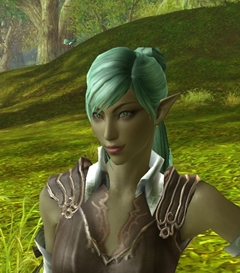
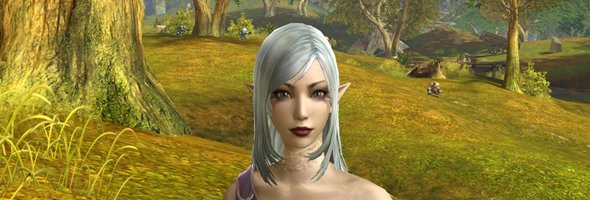
Here’s the look I’m currently sporting. I find it ironic that Phaelia of Resto4Life couldn’t wait to get rid of her facial tattoo–I couldn’t wait to get one!
Below, you can see yesterday’s pigtailed look. It was a good thing too, because my hair was out of my way when I got sick from too much Halloween candy. Carmelita, to my left, is pretending not to know me.

All this, after I promised Briolante I wouldn’t change my hair. . . much. My favorite tank/ significant other extraordinaire says he’s very glad I always look the same in tree form. Syd just doesn’t look like herself these days.
Oh well, at some point there will probably be a return to my long mint-green locks.


I'm Matticus and I play a Dwarf Priest. My home is in Carnage, a raiding Guild. Every week, I log 11 hours raiding on Ner'Zuhl.
Wynthea is the Troll Priest with the best Mohawk on Nazjatar. Currently, I raid 5 nights a week, and PvP occasionally. I started working toward end-game in May 2007, and my guild is currently working through Sunwell. I've tried playing other classes, but Priests are my passion; I've found our racial spells an endless source of fun and frustration. I am extremely fond of Dwarves.... especially with Ketchup.
My name is Sydera and I like to heal things--think Florence Nightingale with foliage. I play a night elf druid on Vek'nilash-US, and I raid 12 hours a week. As a guild officer for Collateral Damage, I coordinate healing and recruit new raiders. I started playing WoW in Fall 2005, and it was love at first click. Before I discovered the joys of Broccoli-stalk healing, I raided as a holy paladin, and I now have alts in all healing classes. I have to say, though, bark beats poofy dresses and heavy plate in my book.